Why I Tore Down My React Portfolio and Rebuilt It in Astro
My old portfolio shipped 519 KB of mandatory JavaScript to render what was mostly a blog. The rebuild ships 23 KB, and if JavaScript fails, the website still works.
My 2024 portfolio was an app pretending to be a content site. My 2026 portfolio is a content site pretending to be an app.
Honestly, the 2024 build was sloppy and a little juvenile. I was reaching beyond what I knew how to do cleanly, and I had about 40 dependencies, a lot of them just there to “look cool.” I rebuilt it from scratch with Astro 7, Content Collections + MDX, Tailwind v4, and a thin layer of progressive-enhancement JS (Lenis + anime.js + View Transitions). It ships about 96% less JavaScript, puts the content back in the HTML, and fixes the SEO, accessibility, and security problems along the way.
The 2024 site
In 2024 I built a React + Vite site for myself, biography, portfolio, blogs, whatever interested me. I wanted the nav reinvented as a sticky sidebar hosting music, live weather, a clock. Very early-2000s-GeoCities inspired. And honestly, it was great… in some ways.
| Criterion | Score | One-line verdict |
|---|---|---|
| Aesthetic and UX Execution | 8/10 | Strong, cohesive point of view. Clean modern skeleton under the retro dressing; layout works. |
| Performance | 3/10 | Ships three.js to paint a solid color. Bloat everywhere. |
| SEO | 3/10 | CSR SPA, meta tags commented out. A blog nobody can find. |
Aesthetic and UX was the real strength. The goal was always simple but pleasant to digest — nothing too bold or disorienting. I’m drawn to sites like the ones on NeoCities: pragmatic but fun, taste beaming through without hurting function. Main content + sticky sidebar still feels clean to me, and I’m happy with how that turned out.
Performance was honestly ridiculous. The funniest example: I was shipping three.js just to render a white background.
<color args={["#f5f5f5"]} />That one line of CSS became 150 KB of WebGL. I’d wanted some cool 3D background effects, hated the result, and kept the canvas “just in case.” That pretty much summarizes the old codebase. The content here is mostly text and a handful of images, but the payload was wildly heavier than the content justified.
SEO was another expensive failure. It was a pure client-rendered SPA: the served HTML was an empty div, and none of the content existed in the markup crawlers saw first. react-helmet-async was installed but commented out, so there were zero per-route meta tags: every page shared one static <title>saman shaiza</title> and one description from index.html. No per-post titles, no Open Graph / Twitter cards — bad ranking and ugly, contentless link unfurls. No sitemap.xml either. The Netlify /* → /index.html redirect is correct for SPA routing, but it just reinforces that everything is the same empty shell.
The Lighthouse numbers weren’t pretty:
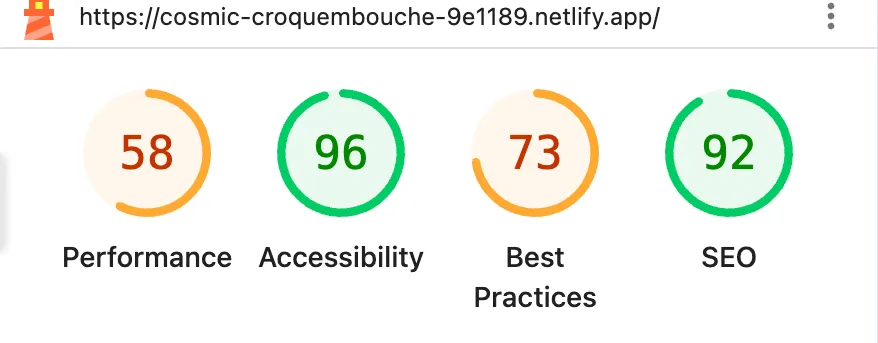
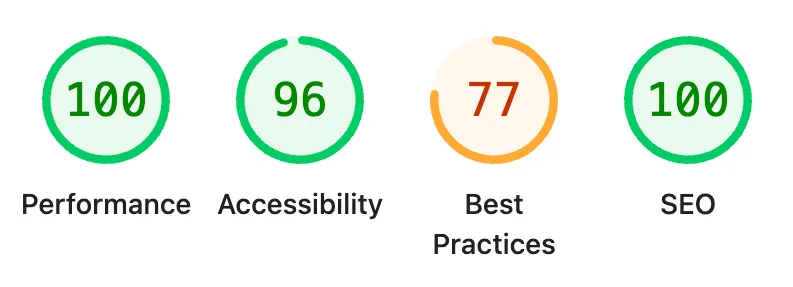
versus where we land in 2026:
There’s more I won’t get into, but the old codebase shows what kind of engineer I am: I move fast, experiment, make a mess, and keep going when an idea isn’t working. That also means dead code piles up.
The 2026 rebuild
I like the idea of a site that evolves. It makes the whole thing feel alive, so I wanted to keep the vibe and structure and fix what was underneath. Astro felt like the obvious fit for a content site: zero JS shipped by default, MDX-native, and SEO and font/image performance basically solved for free. I dropped R3F and the unused libraries, swapped motion/framer-motion for anime.js, and self-hosted the GIFs.
The tempting instinct was to bolt on a backend so I could store more blogs, images, audio. But no, a backend makes a content site slower, not faster. Astro renders content to static HTML at build time; adding a runtime fetch would add a round-trip for content that never changes per request. Dumb.
The rule I landed on is pretty standard:
| Content | Where | How |
|---|---|---|
Blog + reviews (.md/.mdx) |
in-repo src/content/ |
Content Collections → static HTML |
| Inline images | in-repo src/assets/ |
Astro <Image> (sharp) — responsive/lazy/WebP |
| Audio, large media | object storage (Cloudflare R2), by URL | never committed to the repo, CDN handles range requests for seeking |
Blogs and reviews got consolidated into one collection, so adding content is now just dropping a file.
Performance: zero JS by default — that’s just what static Astro HTML gives you. The 23 KB we do ship is Lenis (smooth scroll) + anime.js + Astro’s View Transition client, all enhancement, all gated on prefers-reduced-motion.
Self-hosted GIFs, pulled from the Wayback Machine instead of hot-linking archive.org. Hot-linking was just silly.
Font subsetting + WOFF2 conversion took 495 KB of OTF/TTF down to 173 KB WOFF2 (−65%). I used pyftsubset from fonttools to keep only the Unicode ranges the site actually uses (Latin, General Punctuation, Arrows, Misc Symbols for ★♡♪, etc.), instead of shipping full glyph inventories a personal English blog will never need. I also added preload hints in Layout.astro for the two render-critical faces (PP Writer Regular, Hanken Grotesk).
SEO: per-page <title> and <meta description> plus Open Graph / Twitter card / canonical, all driven through Layout.astro props. @astrojs/sitemap generates sitemap-index.xml at build. Content is server-rendered into the HTML, so crawlers and link unfurls see real text, not an empty shell. og:image points at the logo now, so shared links look intentional.
Motion, done right: every decorative animation respects prefers-reduced-motion. Button hover lifts and shimmer, Lenis smooth scroll, and anime.js scroll-ins are all gated. The head guard only hides [data-animate] when motion is allowed and JS runs, so no-JS / reduced-motion users always get fully visible content — no flash, no stuck-hidden state.
Astro 7 landed two days before I started the migration, so call it fate. I leaned hard into static output, islands, and Content Collections with the glob loader + Zod schema. Frontmatter is type-checked at build, so a bad date or missing title fails the build instead of shipping broken. Built-in Shiki syntax highlighting meant I could drop prism-react-renderer and react-syntax-highlighter, too. View Transitions were the real find: SPA-style navigation with the persistent sidebar (a core part of the 2024 feel), without needing React Router at all.
The numbers (measured 2026-06-27)
Both built locally. 2024 measured with npx vite build (TS check skipped; bundle is representative). 2026 measured with astro build.
| Metric | 2024 (React/Vite SPA) | 2026 (Astro 7 static) | Delta |
|---|---|---|---|
| JS shipped (gzip) | 519.36 KB (one chunk) | 22.83 KB total | −95.6% (~22.7× smaller) |
| JS shipped (raw) | 1,851.31 KB | 65.4 KB | −96.5% |
| JS is… | required to render anything | optional enhancement | — |
| CSS (gzip) | 8.41 KB | 6.99 KB | −17% |
| Served HTML | 0.65 KB empty shell (<div id="root">) |
full content in markup (home 16 KB raw / 4.5 KB gzip; a blog post 72.7 KB raw / 11.1 KB gzip) | content is now in the page |
| Direct dependencies | 38 deps + 19 devDeps = 57 | 7 deps, 0 devDeps | −88% |
node_modules on disk |
386 MB | 168 MB | −56% |
| Build output | 1 monolithic JS chunk (Vite warns >500 KB) | 10 pre-rendered HTML routes + 2 small JS files | — |
| Build time | ~4.82 s (bundle only) | ~2.9 s total / 1.32 s page-gen for 10 routes | — |
| Favicon | Photo-1.jpeg — a 764 KB JPEG |
generated 16/32/180 px PNGs (sub-KB) | — |
| Fonts | 3× OTF (~125 KB each), only Regular @font-face’d |
4× subset WOFF2, 173 KB total (−65%) + preloads | done |
| Lighthouse (lab) | not measured at rebuild time | Perf 99 · A11y 96 · Best Practices 77→~95 after headers · SEO 100 | — |
519 KB of gzipped JavaScript down to 23 KB, and the old 519 KB was load-bearing, the page was blank without it, while the new 23 KB is pure enhancement: smooth scroll, scroll-in animations, SPA-style nav. The 1.85 MB raw 2024 chunk included React, React Router, both framer-motion and motion, and three.js, the last of which existed to render <color args={["#f5f5f5"]} />, a solid color one line of CSS does for free.
The 2024 site wasn’t a mistake. It’s how I learned what mattered: there’s a difference between a site that looks like it cares and one that actually does. I’ve uploaded the 2024 site here so you can see for yourself which one you like better.